An international team of stroke experts from Australia’s first Mobile Stroke Unit (MSU) have proven an innovative, virtual way of delivering care can provide outcomes that are just as good as in-person, saving time and lives.
Findings from the research, published in the latest edition of the prestigious New England Journal of Medicine - Evidence, show that a virtual neurologist can safely and efficiently guide treatment on an MSU, removing the need for an on-board neurologist and offering a breakthrough in the way acute stroke care can be delivered in the pre-hospital setting.
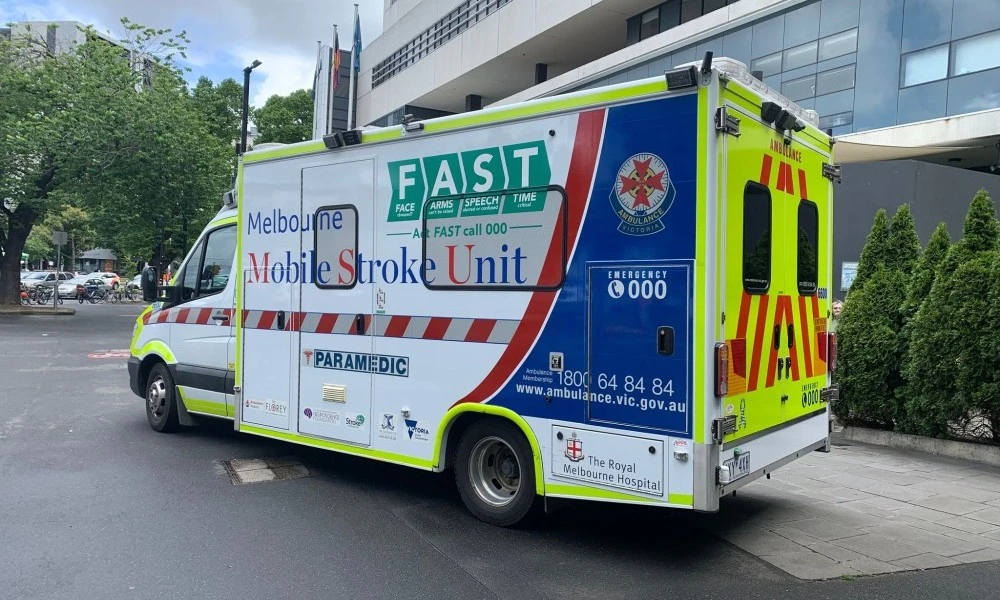
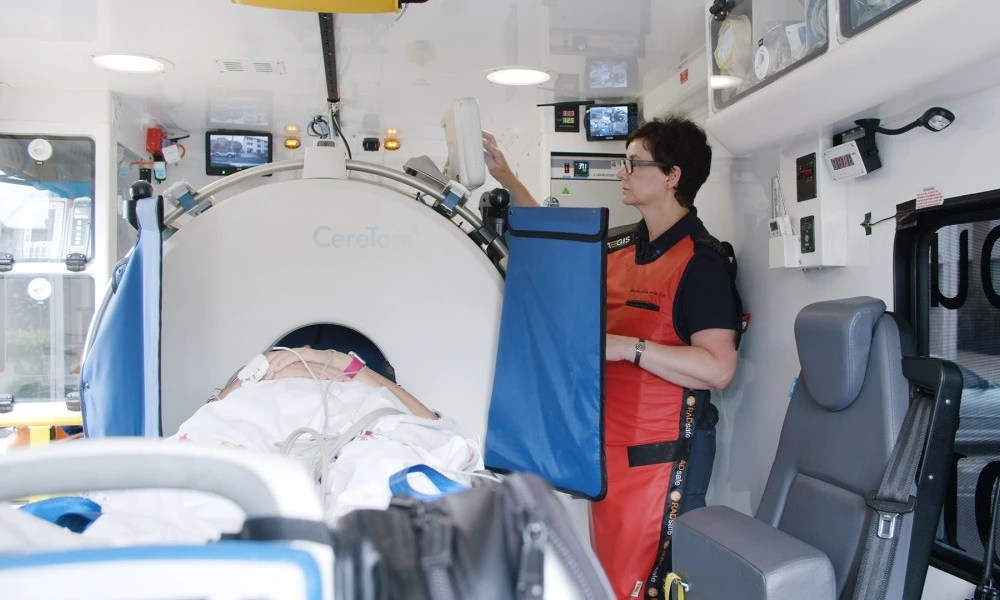
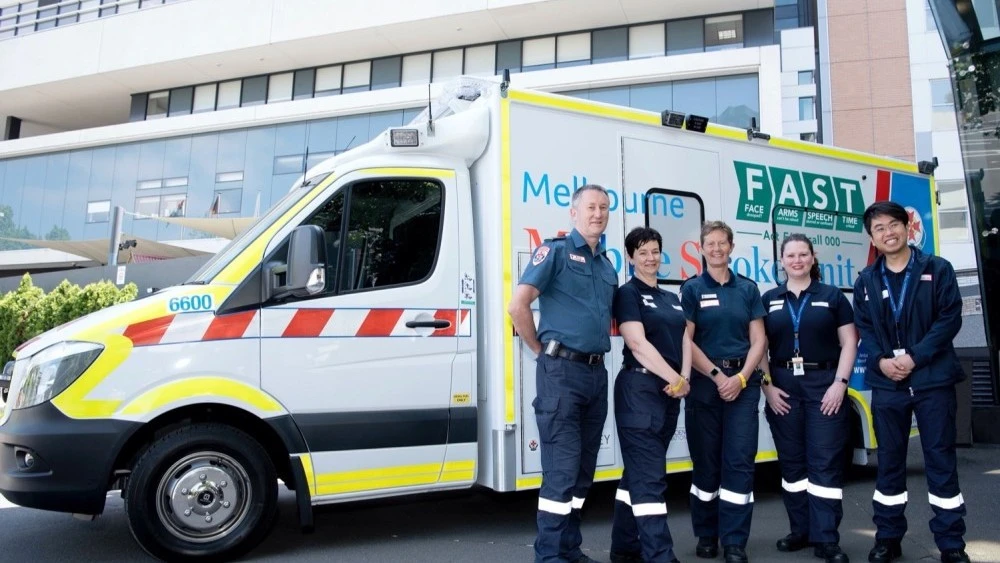
The MSU is a purpose-built ambulance that contains an on-board CT scanner and expert stroke team – two advanced care paramedics, a stroke nurse, and a radiographer – who are dispatched to patients thought to be having a stroke in the community, enabling treatment to begin before the patient reaches hospital.
The initiative is led by the Royal Melbourne Hospital (RMH) in collaboration with organisations including Ambulance Victoria, the University of Melbourne, the Florey Institute of Neuroscience and Mental Health, the Australian Stroke Alliance, Stroke Foundation, and the Victorian State Government.
The MSU-TELEMED trial, conducted between the RMH and international partners including the Ottawa Hospital Research Institute, was the first controlled study worldwide to directly compare on-board neurologist care with remote telemedicine care in pre-hospital stroke patients.
Across 168 operational days, 275 patients with suspected stroke were assessed, generating some of the strongest evidence to date for expanding telemedicine-supported critical care.
The research found that virtual neurologists delivered care that was just as safe as having a physician on board the ambulance.
Treatment decisions were made only a few minutes later - a difference shown to have no meaningful impact on clinical outcomes, while telemedicine offered a dramatic gain in efficiency.
Co-author of the research and Director of the Melbourne Brain Centre at the RMH, Professor Stephen Davis, said the findings would help streamline care and provide positive patient outcomes.
“Telemedicine allows us to utilise state-of-the-art technology to deliver world-class stroke expertise wherever the patient is - not just where a neurologist happens to be,” Prof Davis said.
“With the first hour after stroke symptoms onset being known as the ‘golden hour’ due to how critical intervention is, this gives us the best chance of reversing damage and saving lives.”
The trial results have recently been implemented by the MSU team, with a virtual neurologist based at the RMH providing life-saving care to patients across Melbourne.
Prof Davis said the results cemented the MSU’s value at the forefront of stroke care and innovation.
“These results show the RMH and our partners are leading the way when it comes to finding smart, safe, and scalable solutions for emergency stroke care,” he said.
The University of Melbourne’s Professor Geoffrey Donnan, co-author of the paper, said the study was proving the benefits of telehealth for stroke treatment.
“This research provides some of the clearest evidence yet that advanced telehealth can reliably and efficiently support complex decision-making in the field,” Prof Donnan said.
“The consistency of results across hundreds of real-world cases demonstrates just how effective this model is, and that it is ready for wider adoption.”
The study’s lead author, Dr Vignan Yogendrakumar – who began the research while at the RMH, before returning to the Ottawa Hospital Research Institute in Canada, said the findings could have a worldwide impact on how MSU programs operate.
“The evidence from this trial may support other programs to transition to a telehealth model, integrating aspects of how care was conducted in this study within the unique context of how a MSU is managed locally,” Dr Yogendrakumar said.
Other findings from the RMH-led trial included strong agreement between the MSU diagnosis and hospital diagnosis and streamlined efficiency, with virtual neurologists spending 100 per cent of their MSU-allocated time directly involved in patient care, compared with 33 per cent of that of on-board neurologists.
It could also offer a practical pathway to expand MSU services into outer-metropolitan and regional communities, where access to neurologists is limited and time-critical stroke treatment is often delayed.
The MSU is Australia’s first mobile stroke service, launching in 2017 with capacity to operate within 20 minutes of Melbourne’s CBD.
In 2024 a second MSU was launched, based in Melbourne’s southeast. There are now over 30 active and emerging MSU programs globally, including in countries across Europe, North America, South America and Asia.
We provide a media service from 6am to 9pm each day. Journalists are welcome to contact our media adviser on-call via the RMH Switchboard on (03) 9342 7000.
During business hours, journalists can email mh-communications@mh.org.au. We do not respond to emails outside business hours.