

The Royal Melbourne Hospital is proud to announce the latest inductees into the RMH Research Hall of Fame, our highest honour recognising outstanding careers and groundbreaking contributions to medical research.
This year, the RMH Research Hall of Fame celebrates the achievements of the following seven individuals:
- Professor Adam Deane, Deputy Director and Head of Research, Intensive Care Unit
- Professor Catherine Granger, Physiotherapist, Allied Health
- Professor Trevor Kilpatrick, Specialist Neurologist
- Professor Sharon Lewin AO, Director, Peter Doherty Institute
- Marian Lieschke, Manager, Parkville Cancer Clinical Trials Unit (PCCTU)
- Professor Dennis Velakoulis, Director Neuropsychiatry Centre
- Professor Ian Wicks, Honorary Clinician Emeritus, Rheumatology
Their dedication, commitment and achievements in their respective fields have not only advanced medical knowledge but have also significantly improved patient outcomes.
The RMH's Chief Executive Professor Shelley Dolan and Chief Research and Innovation Officer Professor James McMahon presented the awards to the seven inductees.
"It is an absolute pleasure and privilege to welcome you to celebrate the newest inductees to the Royal Melbourne Hospital's Research Hall of Fame alongside our peers, colleagues and the wider RMH community," says Prof McMahon.
"The Research Hall of Fame is one of the highest research honours and recognises the contributions of research in healthcare.
"The inductees will join the Research Hall of Fame honour wall, located at the level 2 south corridor at the RMH Parkville," adds Prof McMahon.
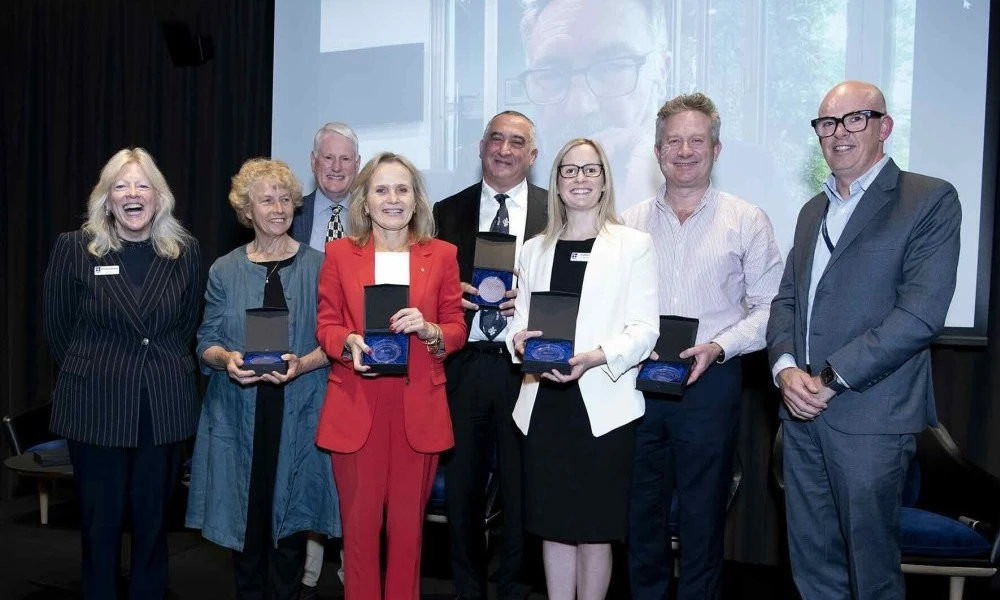
Professor Adam Deane is a leading critical care researcher, consultant intensivist and research leader whose work has transformed the care of patients around the world. Since joining the RMH Intensive Care Unit (ICU) in 2016, he has served as Deputy Director and Head of Research, driving research that improves outcomes for critically ill patients through practical, evidence-based interventions.
His work has transformed international practice in critical care nutrition, glucose metabolism, gastrointestinal function and stress ulcer prevention. He co-authored the landmark TARGET Protein study, which reshaped global nutrition guidelines for intensive care patients, and the REVISE trial, which demonstrated how a low-cost intervention could improve outcomes while reducing healthcare costs worldwide. More recently, Professor Deane has pioneered electronic medical record-embedded clinical trials in Australia, helping shape a new model for efficient and scalable clinical research.
Professor Deane has authored more than 320 peer-reviewed publications, secured more than $30 million in research funding, and been published in leading journals including The New England Journal of Medicine and JAMA. His contributions have been recognised through numerous awards, including the Melbourne Clinical Researcher of the Year Award and the University of Melbourne Medicine, Dentistry and Health Sciences (MDHC) Discovery Award.
A committed mentor and educator, he has supervised researchers across multiple disciplines and is widely recognised for his leadership in developing the next generation of clinician researchers.
Professor Catherine Granger is a physiotherapy researcher whose work has transformed rehabilitation and exercise care for people with lung cancer, critical illness and respiratory disease. Since joining the RMH in 2012 as Head of Physiotherapy Research, she has played a pivotal role in building a strong research culture, establishing the inaugural Physiotherapy Research Committee and leading research capacity-building initiatives across allied health.
A Professor of Physiotherapy at the University of Melbourne, Professor Granger has developed a world-leading cardiorespiratory physiotherapy research program that has directly influenced patient care, clinical guidelines and health services in Australia and internationally. Her landmark research demonstrated the benefits of exercise for people with lung cancer and helped establish rehabilitation as a key component of cancer care. Subsequent studies and clinical trials have informed evidence-based approaches to perioperative physiotherapy and rehabilitation, including practice changes at the RMH and beyond.
Professor Granger has authored more than 140 publications, secured almost $10 million in competitive research funding and been recognised among the world's most-cited researchers. A highly respected mentor and educator, she has supervised 16 PhD candidates and received the University of Melbourne's highest award for PhD supervision. Through her research leadership, governance contributions and commitment to consumer engagement, Professor Granger has made an enduring impact on research excellence and patient care at the RMH. Professor Granger is also a Fellow of the Australian College of Physiotherapists (FACP).
Professor Trevor J Kilpatrick is a world-renowned neurologist and neuroimmunologist whose career has transformed the understanding and treatment of multiple sclerosis (MS). A long-standing member of the RMH community, he began his journey as a medical student. He went on to found the organisation's MS and Neuroimmunology Service in 1995, helping establish the RMH as an internationally recognised centre for MS clinical care, research and innovation.
Over three decades, Professor Kilpatrick has made pioneering contributions to neuroscience, including landmark discoveries in neural stem cells, myelination, neuroinflammation and the genetic and environmental drivers of MS. His research has advanced understanding of disease mechanisms, informed the development of new therapies and helped shape modern approaches to diagnosing and treating progressive MS. He also played a key role in introducing haematopoietic stem cell transplantation for MS in Australia and has led major international collaborations investigating potentially modifiable risk factors for the disease.
Professor Kilpatrick has published more than 300 peer-reviewed papers, attracted more than $30 million in competitive research funding and amassed more than 19,000 citations. An internationally respected research leader, he has held senior leadership roles at the University of Melbourne and The Florey and has mentored generations of clinician-scientists. His enduring commitment to research, education and patient care has left an extraordinary legacy at the RMH and across the global neuroscience community.
Professor Sharon R Lewin AO is an internationally recognised infectious diseases physician-scientist whose pioneering research has transformed the global understanding of HIV persistence and cure strategies.
As the inaugural Director of the Peter Doherty Institute for Infection and Immunity, a Melbourne Laureate Professor at the University of Melbourne, and a consultant physician at the RMH, she has combined scientific excellence, clinical leadership and global advocacy to advance infectious diseases research and patient care.
Widely regarded as one of the world's leading HIV cure researchers, Professor Lewin has made fundamental discoveries into why HIV persists despite effective treatment, and led innovative, early phase clinical trials for HIV cure. Her work has developed highly sensitive methods to measure latent HIV reservoirs, identified key mechanisms of HIV latency and informed clinical trial design globally. She has also made significant contributions to understanding HIV-hepatitis B co-infection, improving knowledge of disease progression and informing patient management strategies.
Professor Lewin's influence extends beyond the field of HIV research. During the COVID-19 pandemic, she led the Doherty Institute's scientific response, helping position Australia as a global leader in infectious diseases research, public health advice and pandemic preparedness. Her research continues to drive the development of novel antiviral strategies for current and future infectious disease threats.
With more than 350 peer-reviewed publications, extensive international leadership and a deep commitment to training the next generation of scientists and clinicians, Professor Lewin has made an extraordinary and enduring contribution to the RMH, global health and the international scientific community.
For more than 25 years, Marian has been a driving force behind clinical trial delivery at the RMH helping build one of Australia's largest and most respected cancer clinical trials programs.
As a dedicated cancer and haematology nurse and leader of the Parkville Cancer Clinical Trials Unit (PCCTU), she has transformed the scale and impact of clinical research, creating greater access to innovative treatments for thousands of patients.
Under Marian's leadership, the PCCTU has grown from 53 staff in 2016 to more than 120 research nurses and data managers working across multiple specialist teams. Her expertise in clinical research, governance and workforce development has enabled the delivery of practice-changing studies across haematology and oncology, including ground-breaking therapies for blood cancers, graft-versus-host disease and immunotherapy. Over the past decade, nearly 6000 patients have enrolled in clinical trials through the PCCTU, helping advance cancer care both nationally and internationally.
A passionate mentor and advocate for professional development, Marian has championed innovative training and education programs that have strengthened Australia's clinical trials workforce. Her contributions to initiatives such as the Australian Clinical Trials Education Centre and the Victorian Comprehensive Cancer Centre (VCCC), Skilled Internship Program have supported the development of hundreds of clinical research professionals.
Respected for her integrity, leadership and commitment to excellence, Marian's enduring impact has shaped clinical trials research at the RMH and created lasting benefits for patients, researchers and the broader healthcare community.
Professor Dennis Velakoulis is a pioneering neuropsychiatrist whose career has transformed the understanding and care of people living with complex neuropsychiatric and neurodegenerative disorders. Since his appointment as Clinical Director of the RMH Neuropsychiatry Centre in 2001, he has combined clinical excellence, research innovation and compassionate leadership to establish the Centre as a nationally and internationally respected leader in patient care, research and education.
In 2004, Professor Velakoulis co-founded the Melbourne Neuropsychiatry Centre, creating a unique partnership between the RMH and the University of Melbourne. His research has advanced understanding of schizophrenia, dementia, epilepsy and neurodegenerative diseases, with pioneering neuroimaging studies helping to redefine knowledge of brain structural changes in serious mental illness. More recently, he has led innovative research into biofluid biomarkers, including neurofilament light chain, with the potential to significantly improve the diagnosis and treatment of people with complex neuropsychiatric conditions.
Professor Velakoulis has published more than 500 peer-reviewed papers, attracted more than $9 million in competitive research funding and generated almost 30,000 citations. A dedicated mentor and collaborator, he has trained generations of clinicians and researchers, helping shape the future of neuropsychiatry in Australia and internationally. Through his unwavering commitment to research, person-centred care and partnership with consumers and families, he has made an enduring contribution to the RMH and the broader neuroscience community.
Professor Ian Wicks is a clinician-scientist whose research and leadership have transformed understanding and treatment of inflammatory diseases and integrated research with patient care at the RMH. As Head of Rheumatology (1998-2021) and a research leader at WEHI (the Walter and Eliza Hall Institute of Medical Research), he has combined scientific discovery and clinical excellence with training and mentorship of clinicians and clinician-researchers.
Professor Wicks established the Reid Rheumatology Laboratory at WEHI in 1996 to study inflammation and autoimmune diseases. His identification of key molecular pathways, including colony stimulating factors, as amplifiers of inflammatory diseases led to novel antibody therapeutics and international clinical trials in rheumatoid arthritis, vasculitis and skin disease. His research has also advanced understanding and treatment of inflammatory cardiovascular disease and introduced evidence-based models of care for osteoarthritis and back pain.
A Fellow of the Australian Academy of Health and Medical Sciences, Professor Wicks has strengthened translational research through leadership of Parkville precinct initiatives: the WEHI and the RMH Alliance (WARMA), Attracting and Retaining Clinician Scientists (ARCS) and the Centre for Biologic Therapies. His mentorship has shaped a generation of rheumatology leaders, leaving a lasting legacy for the RMH, Australian medicine and the broader research community.
We provide a media service from 6am to 9pm each day. Journalists are welcome to contact our media adviser on-call via the RMH Switchboard on (03) 9342 7000.
During business hours, journalists can email mh-communications@mh.org.au. We do not respond to emails outside business hours.